![]() |
|||||||||
![]() |
|||||||||
|
School Students Algebra Quadratics |
|||||||||
|
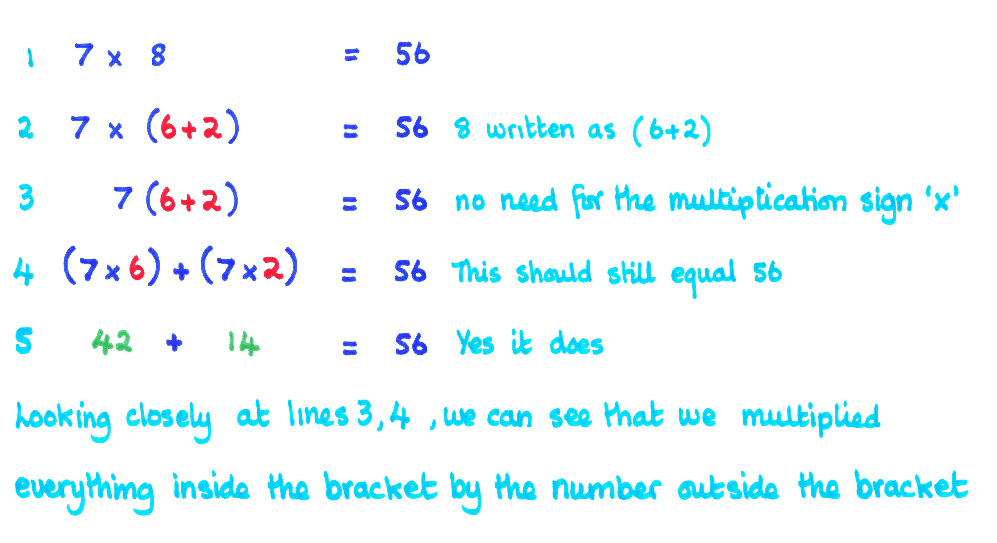
What is factorising and why do we do it? Algebra can be seen as a shorthand with letters. A letter can represent an object, price, almost anything which saves writing out in full each time what the letter is standing for. Now factorising is like shorthand with the actual letters. This will make the expression look nicer. That is if you feel that any mathematical expression can look nice. I like to say that factorising is putting brackets into the expression. Now brackets is a different way of writing a multiplication. Lets have a look at some numbers to try and get an idea of what is happening.
Usually we would not write the multiplication sign in line two 7 x (6 + 2) = 56 so it would look like this but it would still mean multiply 7 (6 + 2) = 56 Now if we look closer at line three; (7 x 6) + (7 x 2) = 56
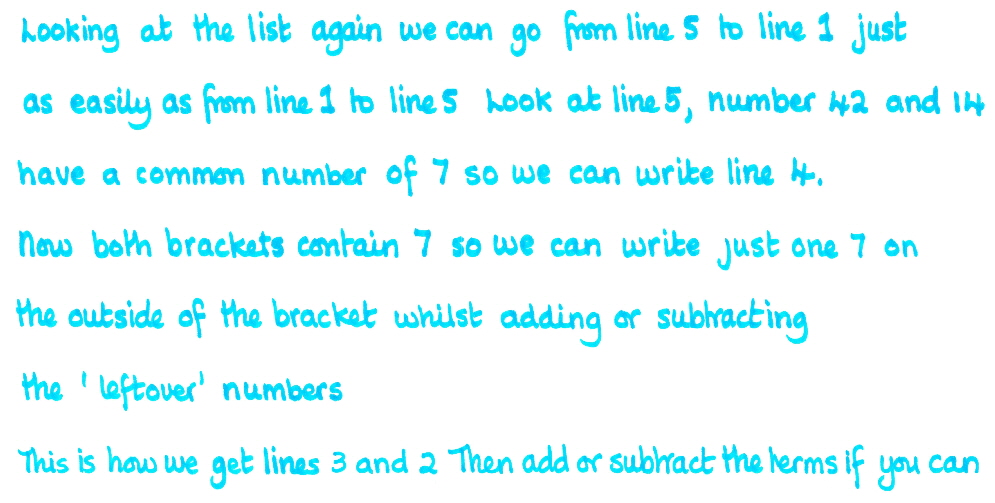
Looking at the list again;
We can go from line five to line one just as easily as we went from line one to line five. Yes we can! Looking at line five, we think of a number that 42 and 14 have in common, and in this case, it is 7. This leads to line 4. Now both brackets have the number 7, so we can use one number on the outside of the bracket whilst adding or subtracting the other numbers. This is how we get lines 3 and 2. Then add or subtract the terms in the brackets if it is possible.
Example Factorise 10ab -10b -10a + 10 First Way
1. 10ab -10b -10a + 10. We can see that 10b is in the first two terms so let’s take that out as a factor.
10b(a - 1) -10a + 10
2. Now we are aiming to get the same bracket, (a - 1), from the second two terms. We are very familiar with taking out positive numbers but if we take 10 out as a factor look what we get
10b(a - 1) + 10( - a + 1)
The second bracket is nearly the same but it has the wrong signs. This should tell us to take out - 10 instead, now look at what we get
10b(a - 1) - 10( a - 1)
Multiply out the second bracket to check you get -10a + 10.
Remember that - 10 times - 1 is 10. Watch out for that whenever you have a negative signs involved with factors. It is a great favourite in exam questions.
3. So now we have 10b(a - 1) - 10(a - 1), we should notice that the two brackets are the same, so we can take it out as a common factor. If you have to think of the bracket as a letter so let it be M. We then get
10bM- 10M and then take out M, we get M(10b- 10)
now putting back the bracket instead of M, we get (a - 1) (10b- 10).
4. Now we can take 10 out as a factor and it is usual to put the number at the start, so we get 10(a - 1) (b- 1) We are at the answer. Second Way1. Look at the numbers and we can see that we have a number 10 in all of them, so we can take this number out in front of the bracket like so:
10( ab - b - a + 1 )
This means that all the numbers inside the bracket are multiplied by 10. I always check by multiplying the bracket out.
2. Now we must concentrate on the inside of the bracket. This bit can be a bit tricky so a little suggestion is to read aloud the explanation and you may find it helps to understand.
So we can see we have b in the first two terms but we have nothing for the second two terms and that does not matter. So we will take b out as a factor (That is the proper name for the phrase “take it out in front of the bracket). We will still need to put 10 outside the first bracket.
10 (ab - b -a + 1 )
10 ( b(a - 1) - a + 1 )
Now this is where you may wonder at the next step. Can you see that we now have the same letters in the inside bracket as out of the bracket?
10 ( b(a - 1) - a + 1 )
Notice the signs are the wrong way around so how can we solve this?
-a + 1 could be considered as - 1a + 1 usually we leave out the 1 in front of a.
Now we have a common number with a twist we will take out - 1 not just one so then we get - 1 (a - 1).
Remember that - 1 times - 1 is 1. Watch out for that whenever you have a negative sign.
I took out - 1 as I knew that would give me the same as the other bracket.
So a tip is if you take out the number but the signs are the wrong way around then take out the negative of that factor number.
So let’s have a look at what we have now
|
|||||||||