Fug

 School Students    Algebra   Quadratics 
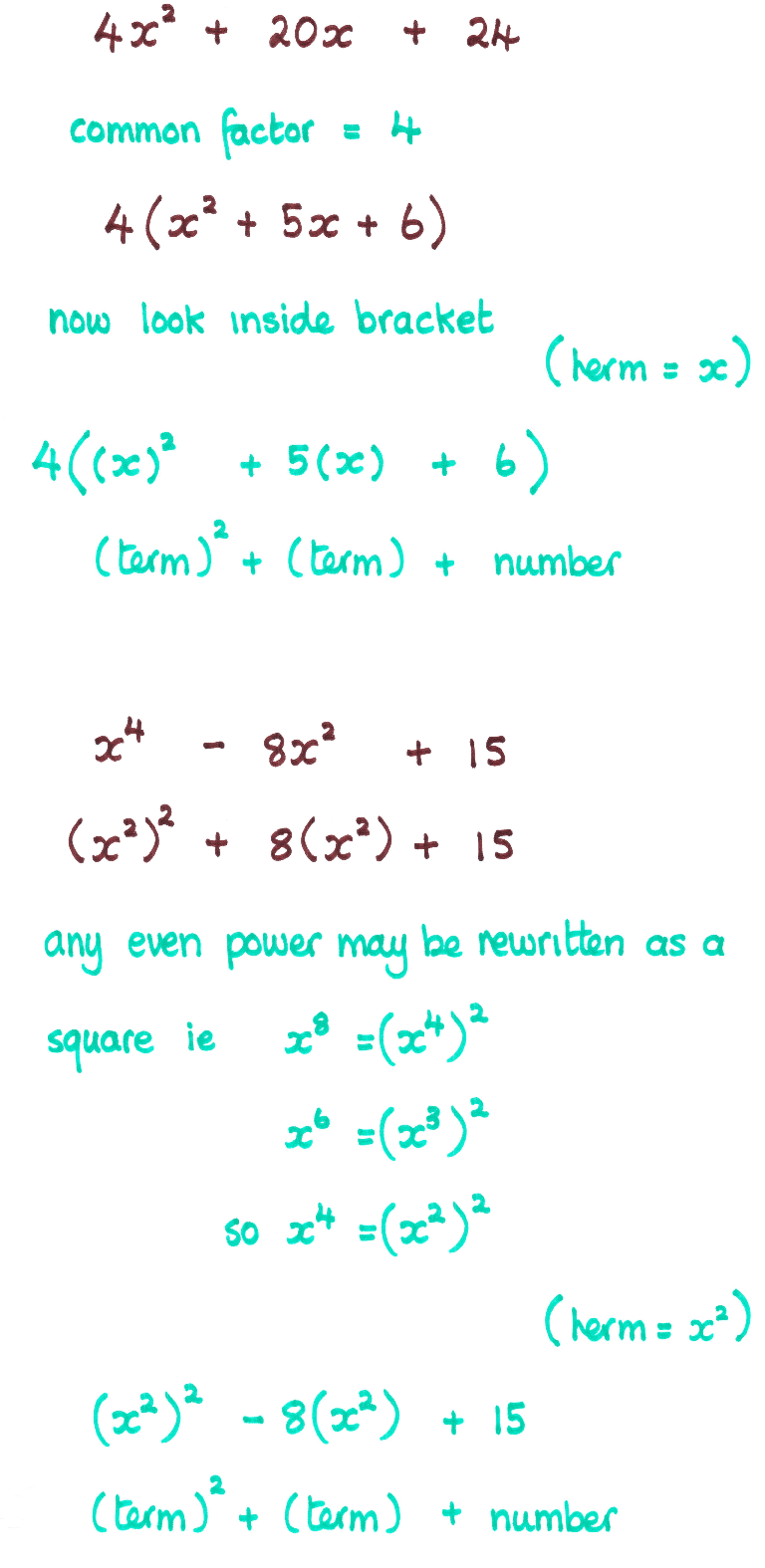
Difference of two squares     Common Factors

Quadratic Factors

This type of factorising really needs to have someone there in person taking you through each step. Alas I cannot do that unless you all pay for my air ticket!
What I am going to try to do is write down exactly what I would say and use lots of colours where I would have done actions ie throwing my hands around etc...
 

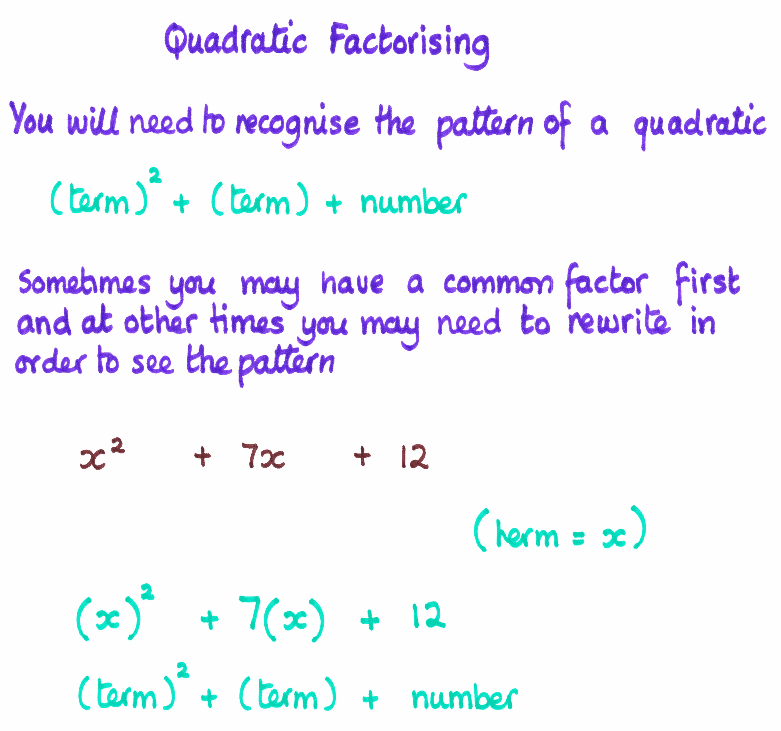
Before we start we should have an idea what a quadratic function looks like. Basically it follows this pattern,

           plus/minus a Squared term plus/minus a term plus /minus a number,

i.e.   y2 + 77y - 104    47a2 - 25a +100

It must be the same letter in the squared term and term.


To begin our journey, lets start with an example of multiplying brackets together and see the pattern. Hopefully this will help us understand how to factorise a quadratic.

     (x + 4)( x + 5)

 I like to have a routine to follow so I always multiply my brackets out the same way.

  1. Multiply the first term in the first bracket by all the terms in the second bracket.
  2. Multiply the second term in the first bracket by all the terms in the second bracket.
  3. Add /subtract all these terms together. Watch out for those Minus signs!
  4. Continue until the last term in the first bracket.

So following this pattern with the above example:

     (+ 4)( x + 5)

    Multiply the first term in the first bracket by all the terms in the second bracket.

    (+ 4)( x + 5) = (x
    x x) + (x x 5) there is more to come, this is just step one!

    Multiply the second term in the first bracket by all the terms in the second bracket.

     (x + 4)( x + 5) = (x x x) + (x x 5) + (4 x x) +  (4 x 5) 

    Stop as the first bracket only has two terms. Notice we add or subtract all of these terms as appropriate.

    (x + 4)( x + 5) = x2  + 5 x  + 4 x + 4 x 5 =  x2  + 9 x  +  20


Notice
x2 comes from multiplying the terms which involved only the letters in each bracket
9x comes from adding the terms which involved the number and letter from each bracket.
20 comes from multiplying the terms which involved only the numbers in each bracket


Try to keep this in mind and do the next few questions but beware of negative numbers when you multiply!

  1. (x + 10)( x -  5)   answer
  2. (x -  3)( x -  6)    answer
  3. (x + 2)( x -  15)   answer

So now we should be happier with expanding brackets, so now we are going to start with the expression and put in the brackets. 

This is what we need to remember from before

 x2  + 9 x  +  20
x2 comes from multiplying the terms which involved only the letters in each bracket

x2 
 + 9 x +  20
9x comes from adding the terms which involved the number and letter from each bracket.

x2 
 + 9 x  +  20
20 comes from multiplying the terms which involved only the numbers in each bracket.
 

This is where all our knowledge of numbers such as factors and multiplication / addition of positive and negative numbers is essential.


The first few examples will all have the coefficient of the squared term as one i.e. x2, h2, etc...


Example One:
Factorise x2 + 7x + 12

We are aiming for something like this, (x plus/minus number)( x plus/minus number) .

If we have two brackets only with two terms in each bracket then the only way to get x2 when you multiply the brackets is (x x x). One x from each bracket. 

Now we have to find two numbers that multiply to give + 12 and add to give +7. I have purposely put the sign even though in this case it is not essential.


Looking at the number 12,

What numbers multiply to give us the answer 12?

    (12 x 1),    (6 x 2),    (4 x 3),   (3 x 4),   (2 x 6 ),   (1 x 12)

    (-12 x -1), (-x -2), (-x -3), (-3 x -4), (-2 x -6 ), (-1 x -12)

The last three brackets in both lines have the numbers the other way around  Then the next line has the same numbers but all negatives since multiplying two negative numbers produces a positive number. Now I have done this here and hope it is not too confusing as some of this is not needed for this particular case.


Now these numbers have to add to give us the answer 7. When the coefficient (number in front) of x is 1, this is quite a simple process. 

Care has to be taken when we have a number other than 1 as this has to be included in this addition.
Remember this number is obtained by multiplying the number from one bracket with a letter from the other bracket and adding the two.

    (x + 4)( x + 5) = (x x x) + (x 5) + (4 x x) (4 x 5) 

            x2             + 9 x     +  20
             

So back to the question, which of these combinations add to give 7? 
We can do this straightaway as the coefficient of x is 1. Simply by adding the two numbers

    (12 x 1),    (6 x 2),    (4 x 3),   (3 x 4),   (2 x 6 ),   (1 x 12)

    (-12 x -1), (-x -2), (-x -3), (-3 x -4), (-2 x -6 ), (-1 x -12)

The bottom line of combinations can be discarded as it gives negative numbers,
   for example     
-12 + -1 = -13

The last three bracket of the first line can be discarded since the answers will be the same as the first three brackets but I will show them for you anyway.


    (12 x 1), (6 x 2), (4 x 3), (3 x 4), (2 x 6 ), (1 x 12)

    12+ 1       6+2      4+3      3+4      2+6      1+12

    13            8            7           7           8           13

We have a winner numbers 4 and 3 whichever way around you write it!!

So now we can rewrite the expression, x2 + 7x + 12  with brackets as (x + 4)( x + 3). 
Of course the answer will be the same whichever way around you write the brackets.
So (x + 4)( x + 3) is the same as (x + 3)( x + 4) just like 6 
x 2 = 2 x 6 = 12

Check now that you return to the first expression when you expand the brackets. Here is the check.         Back to limits

So now we will go through another example, and we will proceed nice and slowly.

Example Two

Factorise x2 + 12x + 32

Since it is just plain x2 , we just have to find two numbers that multiply to give +32 and add to give +12.


Start with 32 and find the combinations of two numbers that multiply to give 32

    (32 x 1),    (16 x 2),   (8 x 4),   (4 x 8),  (2 x 16 ),   (1 x 32)

    (-32 x -1), (-16 x -2), (-x -4), (-4 x -8), (-2 x -16 ), (-1 x -32)


Now we need for these to numbers to add to give us +12, so we can see that the bottom line will only give negative numbers, so we will ignore this line.

So let us see which combinations add to give +12

    (32 x 1),    (16 x 2),   (8 x 4),   (4 x 8),  (2 x 16 ),   (1 x 32).

    (32 + 1),    (16 + 2),   (8 + 4),   (4 + 8),  (2 + 16 ),   (1 + 32).

      33,              18,            12,          12,           18,           33.


We have the winning numbers 8 and 4 whichever way around you write it!!

So now we can rewrite the expression, x2 + 12x + 32 with brackets as (x + 8)( x + 4). 
Of course the answer will be the same whichever way around you write the brackets.
So (x + 8)( x + 4) is the same as (x + 4)( x + 8).

Check now that you return to the first expression when you expand the brackets. Here is the check.


Example Three

Factorise x2 + 5x - 24

How strange it is still plain x2, so we need to find two numbers that multiply to give  -24 and add to give +5

So here are all the combinations of two numbers that multiply to give -24
Remember multiplication of positive and negative numbers


    (-
    24 
    x 1),  (-12 
    x 2),  (-x 3),  (-6 x 4),  (-2 x 12 ),
    (24 
    x -1), (12 x -2),  (8 x -3),  (6 x -4),  (2 x -12 ),


Now we cannot discard any line as there are different values when added together

Remember addition of positive and negative numbers

    (-24 x 1),  (-12 x 2),  (-x 3),  (-6 x 4),  (-2 x 12 ),

    (-24 + 1),  (-12 + 2),  (-8 + 3),  (-6 + 4),  (-2 + 12 ),

       -23,            -10,             -5,             -2,             10,


    (24 
    x -1), (12 
    x -2),  (8 x -3),  (6 x -4),  (2 x -12 ),

    (24 + -1), (12 + -2),  (8 + -3),  (6 + -4),  (2 + -12 ),

      23,            10,               5,               2,             - 10,

So the two numbers are 8 and -3

So now we can rewrite the expression, x2 + 5x - 3 So now we can rewrite the expression, x2 + 5x - 3 with brackets as (x + 8)( x - 3). 
Of course the answer will be the same whichever way around you write the brackets.
So (x + 8)( x - 3) is the same as ( x - 3)(x + 8).

Check now that you return to the first expression when you expand the brackets. Here is the check.


Back to the top

Back to Algebra


Home

Contact me

About me

Services

Feedback

Events

BuiltWithNOF